Search Results for "27 Inch UltraGear™ evo AI GM9"
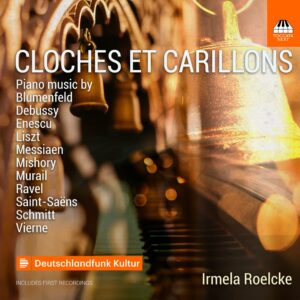
Cloches et Carillons
The piano is perhaps better suited than any other instrument to evoke the sound of bells – evening bells, bells of farewell and of joy, funereal bells, bells with spiritual overtones – and late-Romantic and twentieth-century French and Russian composers in particular have responded to the challenge of capturing those sonorities at the keyboard. This recital explores three centuries of pianistic tintinnabulation, and its ability to capture atmosphere and emotion.
Irmela Roelcke, piano
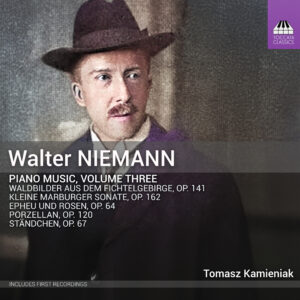
Walter Niemann: Piano Music, Volume Three
The largest part of the output of the Hamburg-born composer and writer Walter Niemann (1876–1953), a student of both Humperdinck and Reinecke, is piano music: an astonishing 1,000 or so pieces, divided into 189 opus numbers. Most of them are lyrical miniatures in a warm and approachable late-Romantic style, some evoking the music of the past – often with a touching degree of dignity and restraint, but also with an occasional flash of good humour. The range of moods here is surprisingly wide, from pieces recalling late Brahms and a barcarolle evoking Offenbach, via light-hearted character-sketches and evocative picture-postcards, to a warm-hearted and tender piano sonata.
Tomasz Kamieniak, piano
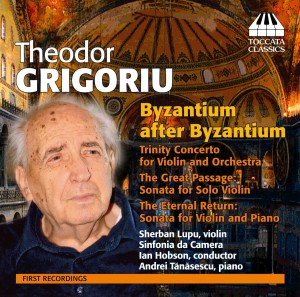
Theodor Grigoriu: Byzantium after Byzantium
Theodor Grigoriu (born in Galaţi, Moldavia, in 1926) is one of the major Romanian composers in the period after Enescu. His vast output is little known outside his own country, although it includes oratorios, symphonies, cantatas, chamber music, film-scores and much more. His musical roots reach back to Romanian folk-music and to the modal melodies of ancient Byzantium — as in this large-scale triptych, Byzantium after Byzantium, which consists of a violin concerto, a sonata for solo violin and a sonata for violin and piano. All three works are performed here by Sherban Lupu, the violinist for whom the music was written.
Sherban Lupu, violin
Sinfonia da Camera, orchestra
Ian Hobson, conductor
Andrei Tănăsescu, piano
Szymanowski’s King Roger: The Opera and its Origins
Foreword by Antonio Pappano
Extent: 171 pages
Size: 24.1 x 16.4 cm
Extent: 171 pages
Composition: Royal octavo
Illustrations: 26
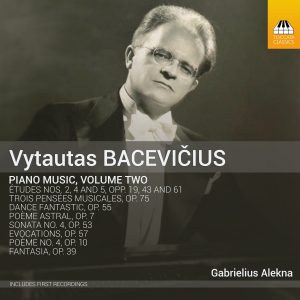
Vytautas Bacevičius: Piano Music, Volume Two
The Lithuanian pianist and composer Vytautas Bacevičius (1905–70) is one of the undiscovered pioneers of the twentieth century. This second volume of his piano music presents works written between 1927 and 1966 and shows the evolution of his musical language from the post-Skryabin style of the early works, via the influence of Debussy, Prokofiev and Stravinsky, to a highly individual modernism, akin to that of his fellow radicals Edgard Varèse and Stefan Wolpe – all three of them Europeans in exile in New York.
Gabrielius Alekna, piano
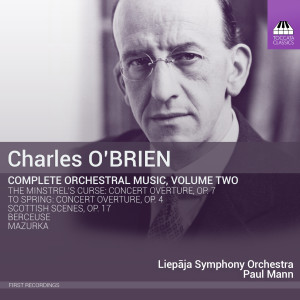
Charles O’BRIEN: Complete Orchestral Music, Volume Two
The rediscovery of the music of the Edinburgh composer Charles O’Brien (1882–1968) continues with this second CD of his orchestral music. Two expansive ‘concert overtures’, the bright Schumannesque To Spring and dark, Lisztian The Minstrel’s Curse – symphonic poems in all but name — contrast with two charming miniatures from O’Brien’s youth and a colourful evocation of Scottish life, in a suite consisting of a tone-poem, an heroic elegy and a dancing finale.
Liepāja Symphony Orchestra; Paul Mann, conductor
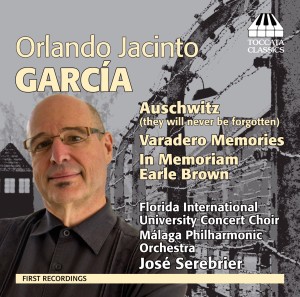
Orlando Jacinto García: Music for Chorus and Orchestra
Born in Havana in 1954, the Miami-based Orlando Jacinto García studied with Morton Feldman and has inherited some of Feldman's concerns: his music likewise evolves gradually over slow-moving spans of time, unfolding like the leaves of a plant, generating colours as with the gentle turning of a kaleidoscope. The elegiac Auschwitz (they will never be forgotten), a meditation for chorus and orchestra, captures something of the infinite sorrow evoked by the memory of such institutionalised cruelty. Varadero Memories is an abstract recollection of a Cuban beach where as a child he spent time with his grandparents. And the hypnotic In Memoriam Earle Brown pays elegant, understated tribute to a seminal figure in American modernism.
Florida International University Concert Choir, choir
Mark Aliapoulios, conductor
Málaga Philharmonic Orchestra, orchestra
José Serebrier, conductor
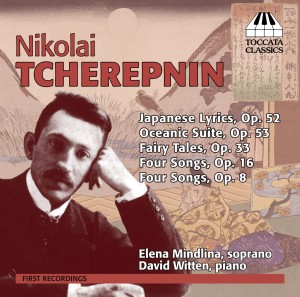
Nikolai Tcherepnin: Songs
Nikolai Tcherepnin (1873-1945) — a student of Rimsky-Korsakov and teacher of Prokofiev — was a Russian-born composer and conductor, and the first of his family's musical dynasty. This CD provides an overview of his ninety-plus songs, which cover a wide range of styles. The early ones are in a late-Romantic idiom; the Japanese Lyrics of 1923 display oriental colours; and the extraordinary Oceanic Suite (1917-23), which sets a series of incantations by the symbolist poet Konstantin Balmont, presents modern evocations of primitive ritual.
Elena Mindlina, soprano
David Witten, piano
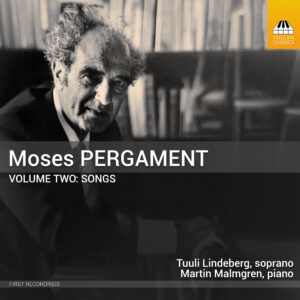
Moses Pergament, Volume Two: Songs
The Swedish composer Moses Pergament (1893-1977) — Finnish-born of Lithuanian-Jewish stock — chose the poems he set to music from a wide range of sources: those heard in this first-ever recording of his songs are mostly in Swedish but also in a variety of other languages. They likewise cover the gamut of human emotion, from buoyant folksongs and children’s verses via lyrical expressions of love and loss to stark meditations on suffering and death. Many of Pergament’s poets evoke the natural world in their expression of emotion, but his music never yields to sentimentality: he treats each song as a microcosm, expressed with drama and dignity. Time was when Pergament’s vocal music was performed by singers of the calibre of Birgit Nilsson, Elisabeth Söderström and Nicolai Gedda; it is high time it was rediscovered.
Tuuli Lindeberg, soprano
Martin Malmgren, piano
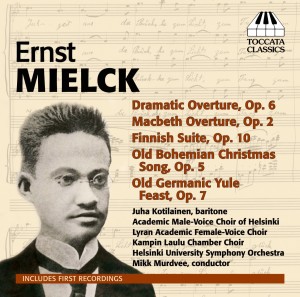
Ernst Mielck: Orchestral and Choral Works
The early death of the Finnish composer Ernst Mielck, in October 1899, two days before his 22nd birthday, robbed music of an extraordinarily gifted musician — he was also a fine pianist — and perhaps one of the major voices of the next generation: the rapid evolution in his language in the three years covered by this CD is striking. The two overtures and cantatas make clear that he was already a gifted composer in the post-Schumann Romantic tradition, and the Finnish Suite written in the last year of his life brings a striking simplification of his textures and what seems to have been a nascent nationalism.
Juha Kotilainen, baritone
Academic Male-Voice Choir of Helsinki, choir
Lyran Academic Female-Voice Choir, choir
Kampin Laulu Chamber Choir, choir
Kari Turunen, chorus-master
Helsinki University Symphony Orchestra, orchestra
Mikk Murdvee, conductor
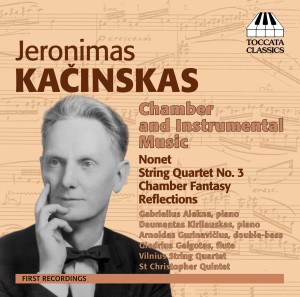
Jeronimas Kačinskas: Chamber and Instrumental Music
The Lithuanian composer Jeronimas Kačinskas (1907-2005) is one of the lost radicals of twentieth-century music. He abandoned traditional syntax in favour of an atonal athematicism, whereby the music is in constant evolution, with freely pulsing rhythms and melodic lines that branch forward like tendrils. His lyrical but tightly woven Nonet was well received in the 1930s, but when Kačinskas fled Lithuania from the approaching Russians in 1944 he had to abandon almost all his scores. Only with the collapse of the Soviet empire could the work be reconstructed — and the composer return home in triumph.
Giedrius Gelgotas, flute
Arnoldas Gurinavičius, double-bass
Vilnius String Quartet, string quartet
St Christopher Quintet, wind quintet
Gabrielius Alekna, piano
Daumantas Kirilauskas, piano
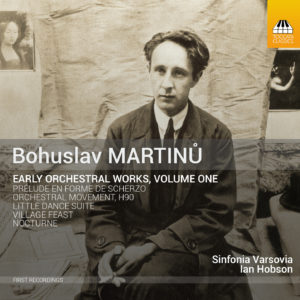
Bohuslav Martinů: Early Orchestral Works, Volume One
Martinů's mature orchestral works are now a mainstay of the repertoire. But the generous quantity of orchestral music he wrote between his late teens and early thirties is as good as unknown. This series of CDs opens that treasure trove, revealing Martinů on the path to mastery. It presents first recordings of some astonishingly attractive music, much of it showing the good-natured influence of Czech folk traditions, some of it evocative and atmospheric — and almost all of it irresistibly charming.
Sinfonia Varsovia, orchestra
Ian Hobson, conductor
Adam Szlęzak, cor anglais
Andrzej Krzyżanowski, flute
Jakub Haufa, violin
Artur Paciorkiewicz, viola
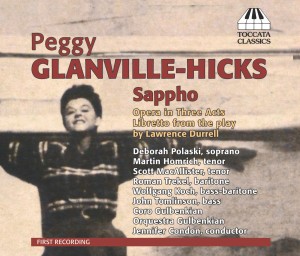
Peggy Glanville-Hicks: Sappho
Sappho, the last grand opera of Australian composer Peggy Glanville-Hicks (1912-90), was written in her stone cottage on Mykonos in 1963. Never heard before this recording, Sappho reflects Glanville-Hicks' fascination with the orient and folk music, encapturing the colours of ancient Greece, with a heroic brass fanfare and epic writing for chorus, haunting woodwind solos and shimmering percussion evoking the stillness of crystal island waters. Deborah Polaski, who creates the role of the disenchanted Sappho, describes it as 'the kind of music that singers want to sing'. The libretto, based on Lawrence Durrell's verse-play, incorporates fragments of Sappho's own verse.
Deborah Polaski, soprano: Sappho
Martin Homrich, tenor: Phaon
Scott MacAllister, tenor: Pittakos
Roman Trekel, baritone: Diomedes
Wolfgang Koch, bass-baritone: Minos
Sir John Tomlinson, bass: Kreon
Jacquelyn Wagner, soprano: Chloe/Priestess
Bettina Jensen, soprano: Joy
Maria Markina, mezzo soprano: Doris
Laurence Meikle, baritone Alexandrian
Coro Gulbenkian, choir
Orquestra Gulbenkian, orchestra
Jennifer Condon, conductor
Double Disc!
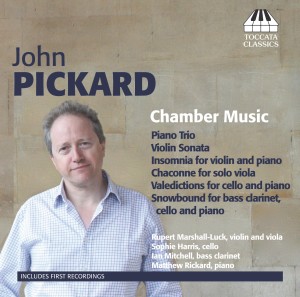
John Pickard: Chamber Music
Reviews of music by the English composer John Pickard (b. 1963) have stated that 'he has the technique and the temperament to emerge as one of the great symphonists of the 21st century', even that 'his place among the greats is secure'. This conspectus of his chamber music traces the evolution of his style over two decades, from the Piano Trio of 1990 to Snowbound of 2010, revealing a powerful rhythmic drive, a feeling for toughly argued drama and a poetic sensitivity to atmosphere among its most prominent characteristics.
Rupert Marshall-Luck, violin, viola
Sophie Harris, cello
Ian Mitchell, bass clarinet
Matthew Rickard, piano
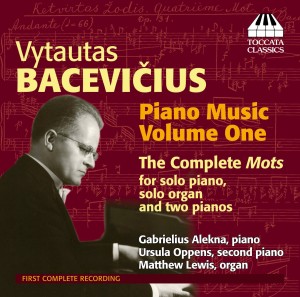
Vytautas Bacevičius: Piano Music, Volume One
The Lithuanian pianist and composer Vytautas Bacevičius (1905-70) is one of the undiscovered pioneers of twentieth-century music. His series of seven Mots ('Words') for keyboard — five for solo piano, one for organ and one for two pianos — were written between 1933 and 1966 and show the evolution of his musical language from the post-Skryabin style of the early works, via the influence of Prokofiev and Stravinsky, to a highly individual modernism, akin to that of two fellow radicals, Varése and Wolpe.
Gabrielius Alekna, piano
Matthew Lewis, organ
Ursula Oppens, piano
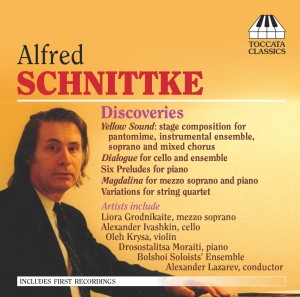
Alfred Schnittke: Discoveries
The output of Alfred Schnittke (1934-98) has been documented in recordings more thoroughly than that of any other Russian composer since Shostakovich. But there are a number of works which have not yet been released on CD, and four of the five here are not only first recordings; they also document Schnittke's stylistic evolution over more than four decades of creative activity, moving from the relatively traditional Preludes, via the serial Dialogue and the experimental Yellow Sound to the elliptical Variations, one of his last works, written in the teeth of enormous physical difficulty.
Drosostalitsa Moraiti, piano
Alexander Ivashkin, cello
Ensemble Pentaèdre de Montréal, ensemble
Jeremy Bell, conductor
Nelly Lee, soprano
Bolshoi Soloists’ Ensemble, ensemble
Alexander Lazarev, conductor
Liora Grodnikaite, mezzo soprano
Oleh Krysa, violin
Natalia Lomeiko, violin
Konstantin Boyarsky, viola